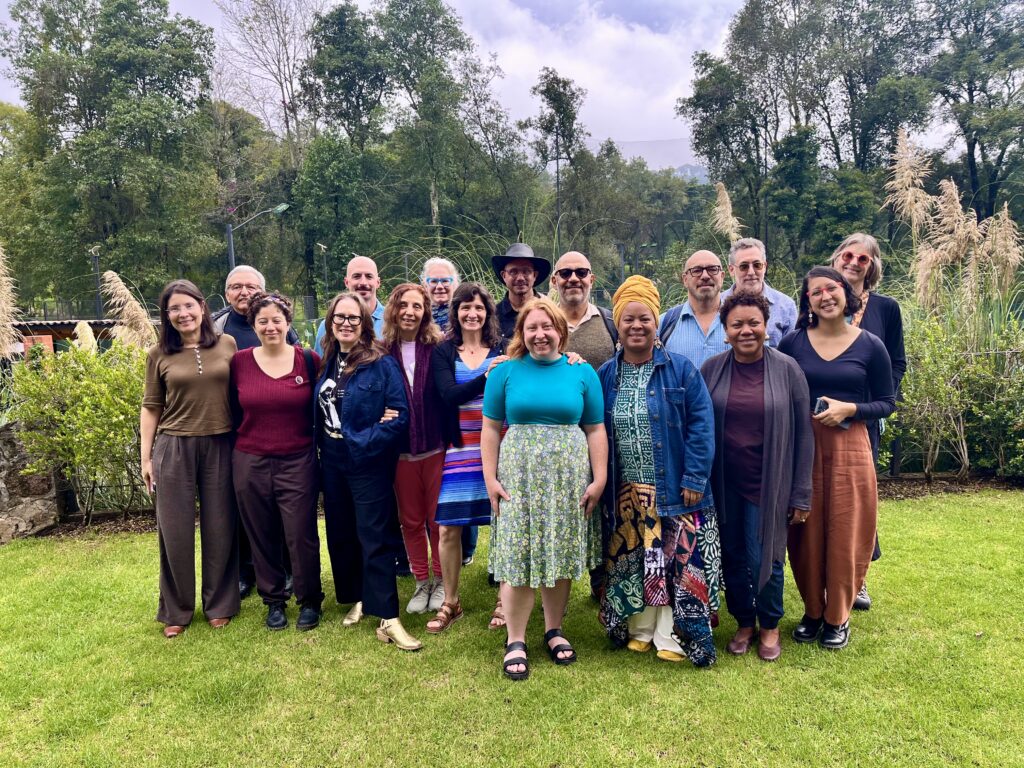
Academic Solidarities and Universities Under Fire
Date
Oct 3 - 7, 2026Organized by
Serena Cosgrove and Irina Carlota [Lotti] SilberLocation
Hotel Avándaro, Valle de Bravo, MexicoParticipants
- Adriana Alas Western University, Canada
- Mike Anastario Northern Arizona University, USA
- Donna Auston Wenner-Gren Foundation, USA
- Lee Baker Duke University, USA
- Wendi Bellanger Universidad Rafael Landívar, Guatemala
- Serena Cosgrove Seattle University, USA
- Nessette Falu University of Texas at Austin, USA
- Cristina Fangmann Universidad de Buenos Aires, Argentina
- Grazzia Grimaldi Swarthmore College, USA
- José Alberto Idiáquez, S.J.
- Jeff Maskovky CUNY Graduate Center, USA
- Osmundo Pinho Universidade Federal do Recôncavo da Bahia, Brazil
- Danilyn Rutherford Wenner-Gren Foundation, USA
- Irina Carlota [Lotti] Silber City College of New York, USA
- Horacio Sívori Universidade do Estado do Rio de Janeiro, Brazil
- Gabriela Zamorano Centro de Investigaciones y Estudios Superiores en Antropología Social, Mexico
ORGANIZER’S STATEMENT: The struggle to protect academic freedom and university autonomy in this period of growing authoritarianism inspires this seminar. We take a hemispheric approach designed to create an ample space for shared reflection about the challenges facing anthropology during an Americas-wide assault on universities and knowledge production itself. Across the Americas anti-intellectual moral discourses circulate alongside direct state repression and neoliberal managerial policies that seek to circumscribe or erase disciplinary contributions for the public good. Universities and their mission to form the next generation of scholars and professionals, carry out pioneering research, and engage societal priorities are being litigated, threatened, and punished. Scholars are at risk. In the context of this authoritarian (re)turn, we (re)imagine anthropology’s global futures within and beyond universities under fire.
Our Wenner-Gren seminar gathers an intergenerational cohort of anthropologists and allied colleagues from countries throughout the Americas – from junior scholars to senior administrators, and from public and private institutions – to push our theoretical and
methodological orientations, revisit foundational texts, and flex our ethnographic engagement. The academic organizers are Serena Cosgrove (Seattle University) and Irina Carlota [Lotti] Silber (City College of New York/CUNY) whose 2020 Wenner-Gren workshop focused on attacks against university autonomy in Nicaragua and the closure of 30 private universities there, some among the last bastions of resistance for human rights. This seminar builds upon that prescient discussion and the resulting volumes that ethnographically document Americas-wide tactics of university repression (budgetary cuts, curricular changes, arrests, deportations and denaturalizations, to name a few) and strategies of resistance that universities pursue to defend their autonomy and protect academic freedom—and what we can learn when these fail.
This is not a romantic or utopic invocation of the power of the academy, the university, or anthropology. Decades deep into productive critique and reimagining, anthropology continues to wrestle with its colonial inheritances while anthropologists face mounting repression as they carry out research that challenges authoritarian priorities. Intent on defending engaged anthropological research and the power of localized, peopled approaches, we intend this seminar to exemplify inclusive practices and invite participants to think together about the urgency of this authoritarian moment. In doing so, this seminar addresses the precarity of anthropology and the very real risks that anthropologists are facing today in their training, teaching, and research. This is precisely a time when anthropology’s promises are more important than ever to push against the silencing of open, critical debate and the surge in global injustice and environmental crises.
We are interested in provoking a conversation about anthropology, academic freedom, and the university, attentive to the trap of reinscribing an institutionalist argument that elides the ample critique of universities as, for example, exclusionary sites that reproduce hyper-individualized expertise for market economies. Rather, we seek to (re)animate the radical projects of the discipline and take what we have learned from a now well-established hemispheric politics of accompaniment and what Cosgrove (2023) theorizes as “academic solidarity.” Expanding our focus beyond Central America, we ask what can global academic solidarity look like in practice? What kinds of institutional partnerships, strategic initiatives, and extra-institutional networks are necessary to confront this moment rife with failure as well resistances? Can we build an abundant anthropological Global Commons (Maskovsky and Rutherford 2025) in the face of scarcity and what innovations and currencies will be needed in this mobilization? We believe that the longterm survival of anthropology’s commitments to decolonial struggles and inclusive society building requires more than north-south conversations; it needs fluid, networked academic solidarity, affective connections across geographies and disciplines.
Seeking to avoid the pitfalls of elitism and gatekeeping that inform conventional academic spaces, this will be an intergenerational and Americas-wide conversation in multiple languages, bringing together anthropologists at different stages in their careers from different countries. We invite participants to convene for three days to interrogate precarity and danger for anthropologists at universities under fire as we map resistance strategies and academic solidarities. Each day of the workshop will be oriented around a broad theme:
Day 1: Authoritarianism and the anthropological endeavor;
Day 2: Academic solidarity;
Day 3: Ethnography as a resistance tool.
We will engage these themes through a range of interventions, including individual provocations in different forms and genres, plenary discussions, collective reading and writing, and engagements with local resistance strategies where we will be meeting in Mexico. Participants will prepare original contributions across a range of forms: testimonials and reflections as well as conventional papers. We imagine this seminar as a collective effort in setting some new – or renewed – orientations for the future of anthropology.