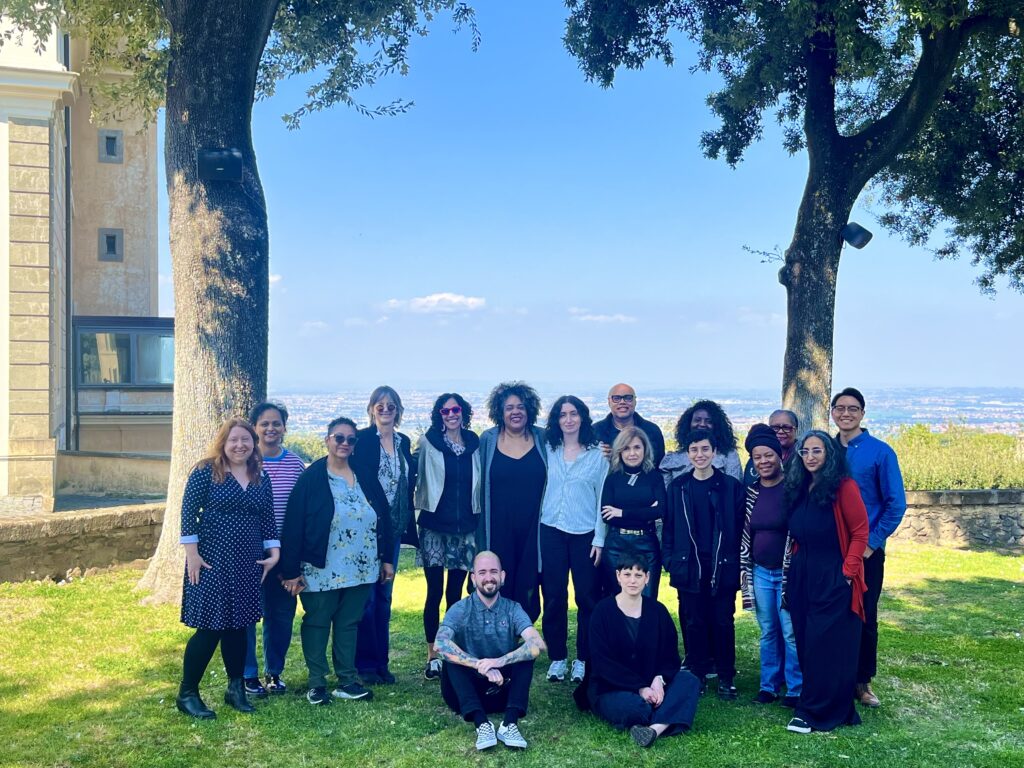
The Past, Present, and Future of Eugenics
Date
Mar 20 - 26, 2026Organized by
Dána-Ain Davis and Sameena MullaLocation
Park Hotel Villa Grazioli Grottaferrata, ItalyParticipants
- Donna Auston Wenner-Gren Foundation, USA
- Dána-Ain Davis Queens College, CUNY, USA
- Christelle Gomis Université de Picardie Jules Verne Amiens, France
- Evelynn Hammonds Harvard University, USA
- Cassandra Hartblay University of Toronto, Canada
- Mansi Hitesh Emory University, USA
- Googie Karrass CUNY Graduate Center, USA
- Andrew Wooyoung Kim University of the Witwatersrand, South Africa
- Fabiola López-Durán Rice University, USA
- Kharnita Mohamed University of Cape, South Africa
- Sameena Mulla Emory University, USA
- Cara Page Changing Frequencies and Healing Histories Project, USA
- Ris Rodina Emory University, USA
- Danilyn Rutherford Wenner-Gren Foundation, USA
- R. Sánchez-Rivera London School of Economics and Political Science, UK
- Damien Sojoyner University of California, USA
- Miriam Ticktin CUNY Graduate Center, USA
ORGANIZER’S STATEMENT: “The Past, Present and Future of Eugenics” will convene in Spring 2026 to put anthropologists into conversation with experts across a variety of fields to ask: where and how has eugenics infiltrated institutional and cultural processes, increasingly located not only in public infrastructures but lodged in private initiatives? Eugenic ideas have persisted in various forms since the late 1880s, and today we find ourselves grappling with what is often termed the “new eugenics,” which advocates for the genetic modification or selection of individuals based on traits presumed to enhance humanity, and institutional measures that seek to preclude the reproductive futures of those who have “unwanted” traits. So-called “unwanted” traits have encompassed disability, criminality, morality, race, poverty, and mental health status. Our workshop explores how eugenic strategies are often scaled up to inform the management and policing of population and space. As eugenics has moved beyond the clinic into many aspects of reproductive health, geography, and everyday life, social scientists, humanities scholars, artists and cultural workers are well-positioned to identify and disrupt these propensities, particularly with an understanding of the present anchored in careful examinations of history.
Participants locate the mechanisms sustaining a diffuse set of eugenic practices that evade efforts to create ethical accountability by drawing on cultural anthropology, biological anthropology, biology, disability studies, history, geography, feminist theory, trans studies, Black Studies, visual arts, and philosophy. Collectively, we engage the ways in which new eugenics informs an increasing number of institutional strategies and interventions. Participants will highlight the notable shift from eugenics as a project rooted in public health, to its increasing location within carceral and policing institutions. The interpellation of eugenic practices into carceral and policing forms thinly masks both the racial and ableist politics at work.
As eugenic technology shifts and migrates, changing in form and location, we must ask who is empowered to control its continuous deployment? Are these technologies in the hands of a select few, and is it possible to organize collective modes of control and collaboration, to ensure a more just future? Is it fear, altruism, desire or anxiety that drives the continued proliferation of eugenics? What might it look like to establish ethical practices and build communities that serve as a bulwark against eugenic formulations that serve discriminatory or authoritarian purposes? These questions require serious thought and multi-pronged solutions considering the intensification of new eugenics across a broad range of institutions, and its creep on restricting the life chances of disenfranchised populations.
Our interdisciplinary and inter-generational community will consider a range of experiences of how eugenic practices, policies circulate in today’s society. Specifically, we will address questions such as: how is the elision of race mirrored in the language of reproductive choice when users privately speculate about the future “erasure” of racial difference, or the selection of racial traits that grant advantages? What are the implications of privatizing eugenics, and to what types of accountability structures are they subject? While historically considered a public project with significant governmental involvement, ethical evasiveness is intensified by the privatization of eugenics. Finally, we experiment with modes of ethical accountability to better scrutinize new eugenics in both historical and contemporary contexts.
This multi-day symposium will include focused discussions of each contributor’s project concerning how eugenic regimes engage familiar and unfamiliar knowledges. Drawing scholars from multiple fields into an interdisciplinary conversation lays the ground for creative, culturally and politically contextualized accounts that build on careful historiography. An ongoing dialogue is essential to navigating the evolving landscape of genetic technologies, clinical practices, physical infrastructure, and carceral policies, ensuring that ethical considerations keep pace with scientific advancements. Examining the strategies of successful disruption of eugenic policy by disability rights activists, often mobilizing feminist tactics, will bolster our political imagination. Ethical imperatives must be brought to bear on new eugenics that draw from a broad range of technological configurations that require the breadth of expertise of the participants who will be part of this workshop.
This gathering will lay the groundwork for a critical set of works that lay bare the location and mechanisms of eugenics within institutional and cultural processes and offer both theories and methods through which to disrupt eugenic practices within both public infrastructures and private initiatives. By including participants with diverse set of expertise at many career stages, we are building capacity to sustain these conversations over time. As eugenics takes on new shapes and forms, we must develop nimble approaches to understanding structure and power toward the goal of dismantling eugenic configurations.