Fejos Postdoctoral Fellow: Marcos Andrade Neves
We’re proud to share the following trailer and blogpost from Marcos Andrade Neves who in 2024 was awarded a Fejos Postdoctoral Fellowship to aid filming, “Not Dead Yet.”
A film about living near (voluntary) death
Not Dead Yet asks what happens when the desire to stay alive is replaced by a wish to die in a specific manner. The film follows the parallel lives of two retired theater actors, Jürgen and Insa, who live in a circus wagon by a lake in Germany, and a Swiss physician, Erika, who provides assistance in dying. Their lives intersected in the past and may converge again in the future. Around them, other stories unfold, such as Freddy’s, which traces the conversations required to receive the “green light,” the authorization to access professional assistance in dying granted by a Swiss organization.
Rather than approaching assisted dying only as a legal or medical issue, the film stays close to everyday life. It traces how people live while anticipating their own voluntary death, or while preparing to assist others in dying. It shows how this anticipation reshapes relationships, conversations, and everyday routines. Waiting becomes a way of living. Planning becomes a form of care. Bureaucratic procedures enter kitchens and bedrooms. Friendship, fatigue, humor, fear, and tenderness coexist with legal documents and medical protocols. Through intimate stories, the film explores assisted dying as a long process that unfolds across months and sometimes years, shaped both by personal desire and by the legal and institutional conditions that make certain deaths possible and others impossible.
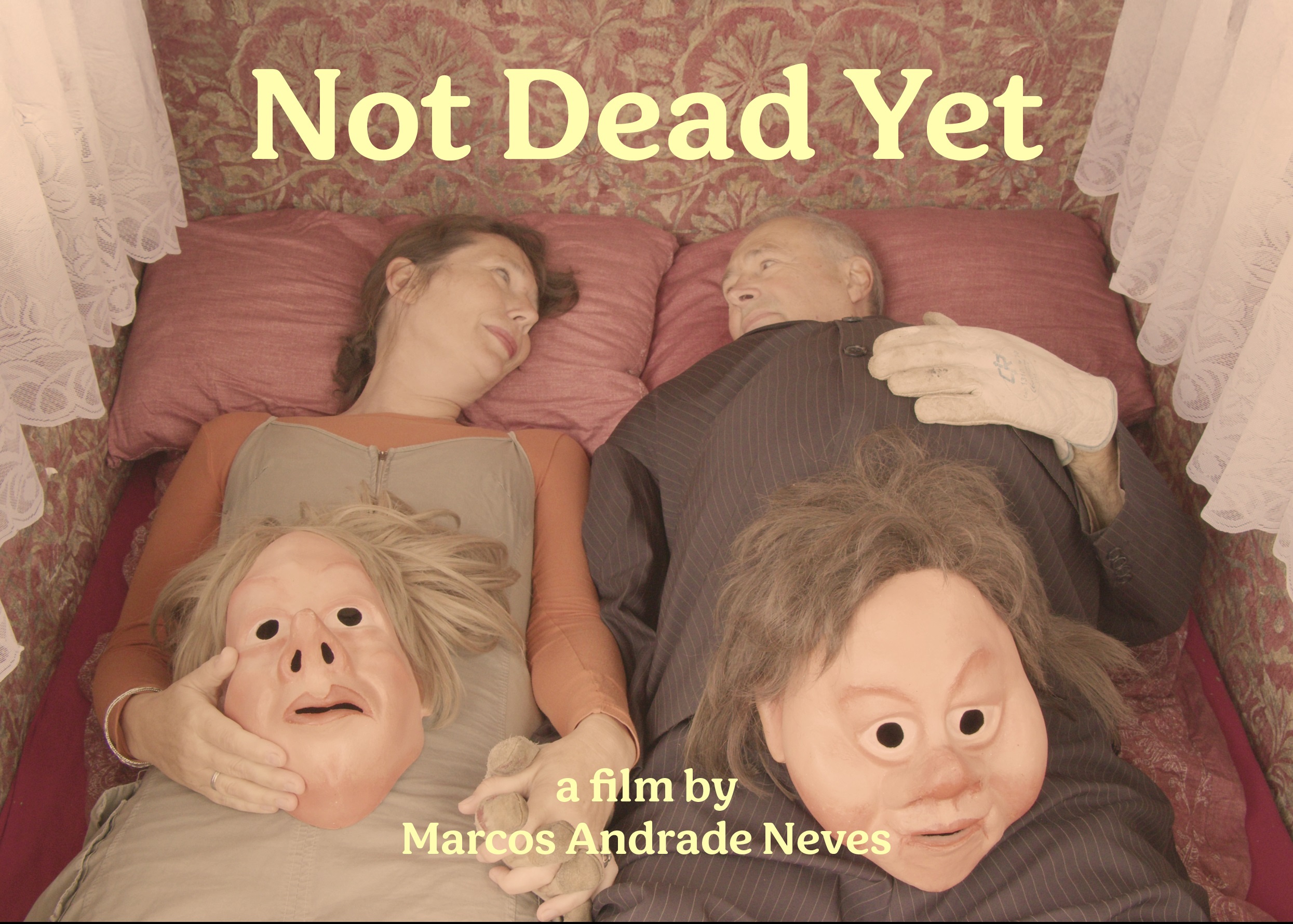
Form: an ethnographic film in hybrid mode
From the beginning, I wanted Not Dead Yet to reflect the diversity of its characters, resisting the more familiar visual grammar of issue-driven documentaries. The film is experimental and hybrid in form. It combines interviews, long observational sequences, voiceover, and theatrical elements drawn from the protagonists’ own artistic backgrounds. This decision grew directly out of ethnographic practice. Assisted dying is not only something people talk about; it is something they rehearse, delay, perform, imagine, and sometimes hide. A purely observational, or talking-heads, mode felt insufficient to capture this layered experience. The hybrid structure allows the film to move between intimacy and distance, between routine and exception, and between what is spoken aloud and what remains suspended in silence.
What the Fejos Fellowship made possible
The Fejos Fellowship was essential in allowing me to complete the most demanding phase of the project. Specifically, the fellowship funded:
- editing work on the cut of the film
- sound design and sound mixing
- color correction and grading
- design work (lettering, title page etc)
- the filming of a small amount of additional footage in Basel, Switzerland
Post-production is where raw ethnographic material is shaped into a visual narrative. It is also where ethical questions re-emerge with particular force: how to protect participants while preserving the integrity of their stories, how to show vulnerability without turning it into spectacle, how to respect moments of silence or indecision rather than forcing them into dramatic structure. The fellowship provided not only financial support but also the time needed to work slowly and carefully with this material. It allowed me to revisit all the footage, refine the rhythm of scenes, and develop a visual language that remains faithful to the complexity of the relationships I was allowed to film. The film’s experimental format emerged through collaboration with the protagonists, in particular Insa and Jürgen, whose theatrical practice inspired the development of a different visual language for telling their stories.
Working across Germany and Switzerland
All main characters in the film are based in Germany and Switzerland, and the film moves between these two contexts. This geographical movement is not incidental. It reflects the legal fragmentation of assisted dying in Europe: a practice that is tightly restricted or prohibited in some countries and cautiously permitted (if not tolerated) in others. For the people in the film, crossing borders is not only a logistical matter. It is an emotional and moral journey shaped by uncertainty, paperwork, financial costs, and the constant risk that laws may change. During the fellowship period, I returned briefly to Basel to film additional scenes that helped clarify how medical routines, legal caution, and personal doubt intertwine in the everyday practice of assisting death. These scenes now form a quiet counterpoint to the domestic life of Jürgen and Insa by the lake.
Ethics, vulnerability, and responsibility
Filming assisted dying requires a particular attentiveness to vulnerability. The people who appear in Not Dead Yet are not only research participants or protagonists. They are people negotiating fear, relief, exhaustion, and determination in situations where the future is radically uncertain. Some conversations took place in moments of emotional fragility. Others unfolded in unexpectedly ordinary circumstances: over coffee, while fixing a boat, while preparing a meal. Throughout the fellowship, I worked closely with participants to decide what could be shown, what should remain private, and how certain scenes would be contextualized. Consent was treated not as a single moment but as an ongoing process, revisited repeatedly as the project evolved.
The film does not include footage of death itself. Instead, it focuses on what precedes it: the waiting, the hesitation, the practical arrangements, the small negotiations between people who
care for one another and do not always agree on what the right decision might be. A brief audio excerpt from the first moments of an assisted suicide procedure is used, only to illustrate the questions that take place at the beginning of each procedure.
Dissemination plans
The primary dissemination route for the film will be through documentary and ethnographic film festivals, with submissions beginning shortly after completion in April 2026. In parallel, I am planning academic screenings at universities and research institutes in Europe and, where possible, in North and South America, where the film can serve as a teaching resource in anthropology. After the festival cycle, I intend to make the film available in open access form, so that it can be used by students, researchers, and the broader public without paywalls. My aim is for the film to circulate not only within anthropology or documentary circles, but also among healthcare professionals, policy researchers, and advocacy groups working on end-of- life issues.
Looking back
The Fejos Postdoctoral Fellowship came at a moment when the project could easily have stalled under the weight of unfinished editing, limited resources, and the emotional difficulty of working with material centered on death. Instead, the fellowship made it possible to treat post-production as a continuation of ethnographic work: a slow process of listening again, watching again, and deciding how to tell a story that does justice to the trust that participants placed in me. Not Dead Yet stays with people as they live in the shadow of a decision that may eventually end their lives, and to show how that shadow reshapes what it means to be alive in the present.
I am deeply grateful to the Wenner-Gren Foundation and to the Fejos Fellowship program for making this work possible.