Fejos Postdoctoral Fellow: Daniele Zappatore
We’re excited to share the following trailer and blogpost from Daniele Zappatore who in 2024 was awarded a Fejos Postdoctoral Fellowship to aid filming, “Nggayuh Indang: Religious Syncretism, Music and Trance in the Ébég of Banyumas.”
The cinematic realization of Nggayuh Indhang represents far more than a mere visual record; it is a collaborative ethnographic document that delves deep into the ébég hobby-horse trance dance of Banyumas, Central Java. From the very start, my intention was to move beyond traditional observational boundaries. Instead, I adopted a participatory methodology where local practitioners acted as architectural partners in shaping the film’s content.
The narrative is anchored by the autobiographical reflections of Rachmat Basuki, an 85-year-old Muslim teacher, expert in the kéjawen spiritual tradition, and a seasoned ébég ritual operator. Through his guidance, the film navigates the intricate ritual preparations and the socio-cultural depth of the performance, transforming raw field research into a medium for ethically shared knowledge.
We focus on two specific themes: the unique religious syncretism of Banyumas and its deep-rooted connection with local traditions of music and dance. Departing from conventional “salvage ethnography” paradigms, the film aspires to transcend mere documentation. It seeks to illuminate the socio-cultural underpinnings that imbue the ébég hobby-horse trance dance with such profound meaning.
This documentary is not meant to represent the ébég as a static, timeless ritual. Rather, it portrays a complex and transformative practice, aiming to understand its true significance to the people performing it. By harnessing the emotive power of the filmic medium, viewers are invited to immerse themselves in the visceral qualities of the participants’ experiences.
The film was entirely edited and post-produced at the DZ Production studio in Rome, Italy, supported by the Wenner Gren – Fejos Postdoctoral Fellowship. Throughout this phase, I prioritized a dialogic process, maintaining constant communication with Javanese collaborators and film participants. This approach was essential to ensure a negotiated representation that respected their cultural perspectives and remained aligned with their expectations.
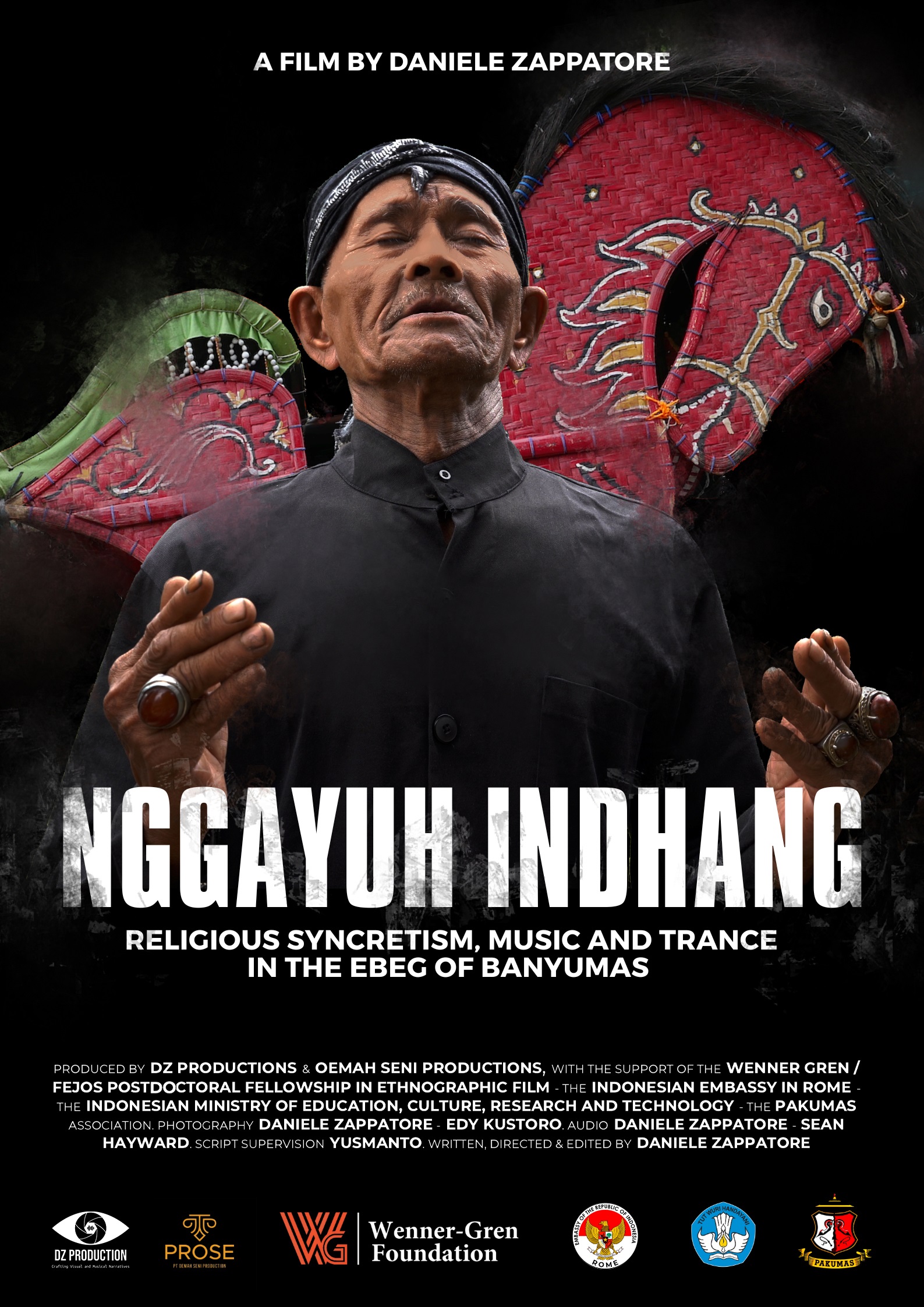
The initial stage of work (June 2025) focused on organizing the extensive footage collected during production (march 2024). All material was gathered with the necessary governmental and individual legal permissions, facilitated by Oemah Seni Production, based in Purwokerto (Banyumas, Central Java). This fixer service, which I co-founded in 2024 with my Javanese colleagues and mentors, Yusmanto and Edy Kustoro, played a fundamental role. Their contribution was vital not only in navigating bureaucratic requirements but also in the creative and practical realization of the entire film project.
Following the organization of the filmed materials, I developed a comprehensive footage transcript and structured the documentary narrative (July – august 2025). While the final structure closely adhered to the screenplay draft originally proposed in the Wenner-Gren – Fejos submission form, the editing process revealed the need for a more definitive conclusion. Consequently, I integrated a closing scene centered on the protagonist’s religious faith, presented as a complementary dimension to his spiritual beliefs. This addition provides a more nuanced and holistic resolution to the film’s narrative arc.
I completed the first rough cut in December 2025. This milestone provided an opportunity to return to Banyumas to screen the edit for the participants and to gather additional documentation for a multimedia compendium designed to accompany the film. The community screening, held at the pendopo adipati mrapat—the historical administrative complex of the Banyumas Regency—was organized with the support of the local government and representatives of the PAKUMAS ébég community. This session was instrumental, allowing participants to review the footage and reaffirm their consent. Furthermore, their vital feedback directly shaped the final editing phase of the film. This collaborative approach not only ensured transparency but also reaffirmed my commitment to ethical research practices and the meaningful repatriation of research outputs to the involved communities.
Following my return from Banyumas in January 2026, I finalized the fine cut and picture lock. I then proceeded with color grading and correction, adjusting the footage to ensure visual consistency and to enhance the intended emotional tone. Concurrently, I focused on the film’s sound design, which involved cleaning ambient audio and integrating the voiceovers co-scripted in collaboration with various participants. These narratives guide and contextualize the footage, fostering a sense of immediacy and intimacy that could not have been achieved through conventional interviews alone.
To underscore specific sequences, I added extradiegetic musical pieces recorded in December 2025 at the Oemah Gamelan Art Center (Pekunden Village). These recordings involved several music teachers with whom I have collaborated throughout my eight years of ethnographic research in Banyumas. Regarding the mixing and mastering, my primary goal was to preserve the “dirty” sound aesthetic characteristic of ébég performances—a bombardment of amplified, distorted, and repetitive sounds. This sonic intensity is crucial, as it plays a fundamental role in triggering and regulating altered states of consciousness among the dancers.
During February 2026 I focused on adding opening titles, lower-thirds, and closing credits. Subtitling required significant effort, as most of the film participants preferred to speak their regional dialect (Bahasa Ngapak), which is central to Banyumas cultural identity. Additionally, since the Javanese mantras and invocations are deliberately obscure, the expertise of Yusmanto—a specialist in Banyumas language, performing arts and spiritualism—was essential. His contribution ensured the subtitles (available in English, Italian, and standard Indonesian) are clear and meaningful without compromising the participants’ expressive style.
The final stage of post-production involved a rigorous legal clearance process to ensure the film’s ethical and judicial integrity. A thorough review confirmed that all necessary participant releases, originally signed in March 2024, were reaffirmed in December 2025. Regarding the soundtrack, both source music and underscore consist exclusively of traditional, field-recorded music. As is common with many oral traditions, these are attributed to the collective rather than individual authors and, therefore, do not require licensing. Finally, as part of a commitment to collaborative practice and community engagement, the film’s rights were formally granted to the Pakumas Association and Oemah Seni Production, ensuring the project remains a shared asset of the culture it represents.
Regarding the marketing and promotion phase of the project, I have developed, in collaboration with the web marketing consultant Fabio Bacchelli, a comprehensive digital hub integrated within my personal website. Rather than simply promoting a product, we structured this space as a “multimedia press kit”—a curated repository designed to bridge the gap between essential promotional assets and deeper intellectual context.
The dedicated page features the film’s synopsis, thematic descriptions, high-resolution stills, and the official trailer. To provide a truly immersive experience, I included a complete film guide (PDF) that blends textual and photographic elements with detailed credits and technical specifications. To further collapse the divide between academic research and creative practice, the hub hosts over 1.30 hours of thematic interviews and analytic audiovisual content I elaborated in March 2026. This approach offers critical insights into the core topics of Nggayuh Indhang, transforming passive viewers into informed participants who can appreciate the rigorous research behind the storytelling.
The film’s development has been rooted in a rigorous cycle of academic engagement and public dialogue. Even during the editing phase, early rough cuts were presented at prestigious international venues, including the 5th ITASEAS conference in Turin, the 4th ICTMD Symposium on Audiovisual Ethnomusicology in Shanghai, and a specialized conference at the University of Cagliari.
Looking ahead, the final cut is set for a series of high-profile screenings throughout 2026. These include upcoming presentations at the Indonesian Embassy in Rome, L’Orientale University of Naples, and Sapienza University of Rome, culminating in a joint ICTMD symposium at Chiang Mai University in Thailand in July. This dual approach ensures the film serves as both a cinematic experience and a significant contribution to the fields of ethnomusicology and anthropology.
As of March 2026, the film has officially begun its journey on the global circuit, with submissions already sent to 25 national and international documentary festivals via FilmFreeway. To maintain creative independence, I am prioritizing a self-distribution strategy: utilizing Vimeo to host the final cut and YouTube for sharing immersive multimedia materials. I will continue the submission process as specialized anthropological film festivals release their upcoming calls for entries, ensuring the project reaches audiences and educational distributors dedicated to ethnographic documentary.
Following the festival phase, I will submit the film alongside a complementary written essay—detailing its contents and methodological framework—to leading audiovisual anthropology and ethnomusicology online journals. This will ensure the work is recognized as a formal, open-source research output that is both discoverable and citable for future scholars.