Fejos Postdoctoral Fellow: Carolina Boe
We’re excited to share the following trailer and blogpost from Carolina Boe who in 2023 was awarded a Fejos Postdoctoral Fellowship to aid filming, “Digital Detention.”
The Digital Detention documentary wouldn’t have been completed without the support of the Wenner-Gren Foundation. Digital Detention is based on two previous anthropological research projects, “Borders Without Fences and Confinement Without Walls”, on the experiences of and business behind the deployment of ankle monitors as so-called “alternatives to detention” by the U.S. Immigration and Customs Enforcement (ICE) (2018-2021, funded by Independent Research Foundation Denmark); followed by “Digital Confinement. The Reconfigurations of Borders and Detention Through New Technologies” (2021-2023, funded by the Carlsberg Foundation), which focused on the uses and experiences of facial recognition app SmartLink. Dissemination of both projects included exhibits and the filming of short videos. The Fejos Grant funded additional filming, editing, color-grading and musicians, who composed and played on the film’s score, and gave me time to transform anthropological research into a documentary.
Being an engaged academic researcher, I have specialized in the anthropology of confinement and border control, working on the entanglements between criminal justice and immigration enforcement, primarily in France and the USA since the early 2000s. My previous research took me to closed institutions where permission to film is rarely granted and poses evident ethical challenges. Whether I wrote academic publications or contributed to human rights reports, I often wished to use film to make visible and audible the experiences of confinement shared with me by prisoners and detainees, conveying their accents, intonations, hesitations and emotions more directly and immediately than is possible through writing. Besides its relevance for research dissemination, visual methods allow to include research collaborators differently in the ethnographic process and in dissemination. Indeed, films reach a larger audience than written words, and, especially when working with persons with different linguistic and reading skills, the process itself of co-creating images is a powerful and inclusive tool.
Transforming Anthropological Research into a Documentary
The documentary is made in collaboration with asylum seekers who have chosen to speak out about their experiences of for-profit surveillance and ICE enforcement – not to improve their own situation but because they don’t want other people to suffer from similar hardships. The project connects around thirty asylum seekers and migrants from Angola, Colombia, Congo, El Salvador, Eritrea, Ghana, Guatemala, Honduras, Haiti, Nigeria, Pakistan, Tchad, and Trinidad and Tobago, as well as numerous community organizers, legal-, data-, and surveillance scholars, and activists. Other professionals, who are committed to social justice issues or/and have experienced migration or forced displacement, have generously contributed with their expertise in translation, sound editing, film editing, or campaigning.
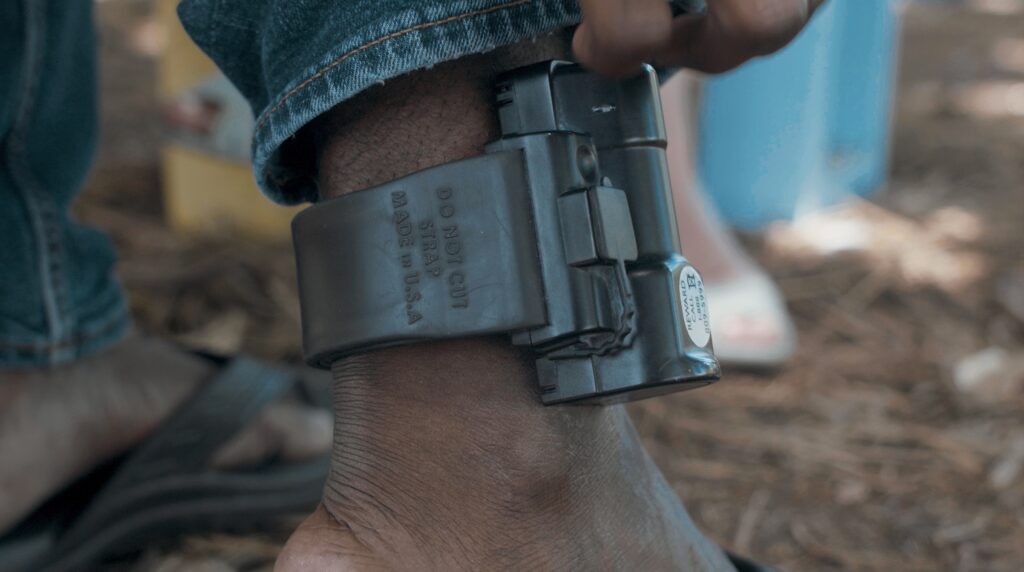
Through the documentary, we wanted to make the experience of electronic monitoring visible. Digital Detention shows how devices strapped on ankles and wrists bruise bodies and create medical conditions; how the constant requirements to recharge batteries or submit to check-ins through facial recognition generate stress and mental health problems; and how the devices produce additional stigmatization of asylum seekers. Overall, the film shows how electronic monitoring is another form of detention, rather than an “alternative” to being detained. This type of surveillance is both inhumane, unnecessary, and a result of the lobbying power of the private prison industry, which sponsors the campaigns of politicians who, in turn, support their expanding network of for-profit detention. We wish to warn citizens against the negative consequences of the spread of digital borders and confinement into our communities, an issue which should concern us all.
Filming and Editing the Digital Detention Documentary
Ethics and Data Protection when Making Films with People in Vulnerable Situations
Some research collaborators fear that they might jeopardize their chances of asylum or legalization if they publicly voice their concerns. In many documentaries, anonymization means blurring faces or silhouettes, and potentially creating a sense of suspicion with viewers. We turned this challenge into an inspiration for the visual language that we developed in close collaboration with those sharing their experiences.
Thanks to Mexican-American videographer Jessie Rodriguez’ careful camerawork and creativity, and by including research collaborators in the choices we made, we created images that give the viewer a sensorial experience of confinement and immobility through close-ups of bodies and surveillance devices, showing the contrasts between their skin and the hard plastic monitors strapped on their ankles and wrists. Filming with someone, choosing what matters to them and how to film it, allows to better understand and convey aspects of digital detention which are invisible, such as the protracted uncertainty and temporal experience of confinement, surveillance and deportability.
Editing the Film
In the editing room, owing to multimodal anthropologist and film editor Thea Svane’s sensitivity, we conveyed the asylum seekers’ sense of time standing still and immobility in the midst of Austin, a city which is being profoundly impacted and colonized by some of the same tech companies that capitalize on the extraction of data. We contrasted scenes of the lack of mobility of asylum seekers in the interior spaces where they have to charge their devices for hours, with scenes from the city they live in: the lush nature, broad avenues and large sidewalks of Austin. Here, other people move around freely, with little knowledge of the forms of digital confinement that takes place in the midst of their community.
To further visualize the power exerted by the tech industry on the lives of asylum seekers and citizens alike, we represented the transformation of the cityscape – traditional wooden houses being destroyed and replaced by condos for tech-workers – as the city is rapidly being gentrified, transforming cityscapes and creating new displacements of populations. My initial fieldwork had taken place in the Summer of 2019, in a city which was already very gentrified, by music, cinema, and an alternative art scene. However, during each additional research stay in the years that followed, the city underwent even more rapid transformations, with tech industry headquarters and workers leaving the saturated real estate market of California to invest in the New Silicon Valley of the South, pushing communities of color and creatives out of the city.
In parallel to editing the full-length documentary, we edited short videos, which were screened during a 2023 webinar organized by the American Bar Association, with several hundred lawyers present, and we contributed written testimonies, photos and videos to a 2024 American Bar Association report and a forthcoming 2026 Georgetown Law report.
Continued Dialogue and Colelctive Counter-Expertise
Thanks to the Fejos Postdoctoral Fellowship that funded additional filming and research stays, Jessie Rodriguez and I documented the transformations of surveillance and of Austin, and I brought raw edits, which Thea Svane and I made in Denmark and France, back for the research collaborators to watch, so that they could have a say in the representation of their stories.
We also organized screenings during community events in Austin. Research collaborators, who were the subjects of the short films and photos we presented, and who took part in these meetings, felt listened to and expressed pride in being part of the project and answering questions. Other persons, who were also monitored and present during these meetings, offered to contribute to the project by sharing their experiences through new research interviews, photos, or the documentary film. The meetings spurred discussions on the for-profit motives behind detention and electronic monitoring and offered opportunities to share my own and other scholars’ research on detention, displacement, surveillance capitalism, or deportability. Research collaborators expressed how the project allowed them to break some of the isolation due to stigmatization in the community. Recognizing a person’s lived experience and how it resonates with scholarship created a sense of empowerment.
Our approach is inspired by other collaborative research projects that owe to scholar Michel Foucault’s activism against incarceration through Groupe Information Prison, which relied on alliances between prisoners and other experts. Here, justice and progressive social change is seen as much as a process as an end state, allowing research collaborators to better understand their experience collectively and contribute to call into account those responsible, as a form of counter-surveillance. Drawing on different skills and knowledge, we contribute to reports, teaching, conferences, photo-exhibits, and community meetings and campaigns. In the process, we make research collaborators’ experiences of surveillance visible in ways that are relevant for them, through interventions in networks of influence, anonymously and safely. We thereby co-create counter-expertise and critical awareness of extractive forms of surveillance, reflect on current and potential futures of confinement, and contribute to collectively answer a question I met numerous times during my initial anthropological fieldwork on electronic monitoring: “Why do they put this on us?”
From Spring 2026, the Digital Detention documentary is being screened in cinemas, universities and community organizations in the USA, Latin America, and Europe, including at EASA in July 2026.
On behalf of the whole Digital Detention team, and as a first-time film-maker, I would like to express deep gratitude to the Foundation’s staff and reviewers who chose to fund our documentary.
Additional Information:
Film website: https://carolinasanchezboe.com/digital-detention-film/
Digital Detention Project Website