Inside Out: The Everyday Lives of Men Behind Bars
Engaged Research Grants support research partnerships that forge ethical relationships and empower those who have historically been among those researched in anthropology. Designed in alliance with individuals who have born the impact of various kinds of marginalization, these partnerships bring together scholars and their interlocutors in the mutual production of anthropological knowledge aimed at combatting inequality and promoting the flourishing of human and more than human worlds. The program supports research that promises to make a significant contribution to anthropological conversations through collaborations in which engagement is a central feature of a project from the very start.
The Foundation is proud to share the final report of an Engaged Research Grant awarded in 2025 to Linda Green entitled, “Inside Out: The Everyday Lives of Men Behind Bars.”
A key goal of Inside Out: The Everyday Life of Men Behind Bars was to understand and to challenge the prevailing public perception of who is incarcerated, why and under what circumstances. Using the conceptual lens of critical autoethnography as both a data collection tool and an analytical framework the project sought to document the lives of incarcerated men who are serving decades-long sentences in a Federal Corrections Institution.
As such we explored the dynamic relationship between lived experiences on the inside and the larger social structures and processes of the criminal legal system that define them. This project drew on insights from incarcerated men as both interlocutors and as C0-PIs, the PI who has worked with vulnerable populations in both the Global North and South and local community partners in the performing arts, as we transformed anthropological data and analyses into dramatic theatre performance.
This project extends what a public anthropology might mean; one that not only includes the voices of incarcerated students as interlocutors but also simultaneously as engaged researchers. This endeavor is one that fosters a decolonial praxis, that is at once collaborative and reflexive and decenters dominant hierarchies and discourses (Salameh 2023). A public voice may then offer a moral and ethical framework for dialogue, creative thought and social bonds, key features of our dignity and our humanity. And in this case, it does so by providing the Co-PIs a terrain from which to raise their voices by creating a public awareness and dialogue about their experiences of mass incarceration shared through dramatic theatre.
The conceptual frameworks of historical realism, embodied violence, the carceral state and decolonial praxis were crucial tools in a quest to open a more robust dialogue between incarcerated men inside and the larger Tucson community outside. Importantly, this study contributes to an understanding of the kinds of challenges incarcerated peoples face, the effects and the panoply of coping strategies that are utilized by them and their families to survive.
The ideas, insights and reflections generated by men inside were shared outside through dramatic performance, thus lending them a public voice. Like anthropology, dramatic theatre shares the possibility of recognizing our own humanity by bearing witness to the humanity of others (Stephens 2010). In this sense theatre has the potential to humanize that which prison dehumanizes and to use dramatic performance as an experience of self-reflection to gain knowledge of one’s social reality from a critical lens.
In their preface to Against Charity, Daniel Raventós and Julie Wark remind us that reciprocity, engagement and kindness are crucial elements in an engaged anthropology, one that moves beyond “do no harm” to one of equality, fraternity and respect.
The research at its core was predicated on three key, related objectives:
- A critical examination of the systematic disparities within the legal justice system that contribute to negative outcomes for many incarcerated people. What are the structural factors that may impede or enhance the relationship between punishment on the inside and the possibilities of rehabilitation and resiliency on the outside. What might resiliency mean under such conditions?
- To explore the ways in which structural, symbolic and everyday violence behind bars give shape to daily life in both the physical and social sense? How might precarity be experienced and embodied? What are the long term social, physical and emotional side effects of these chronic experiences of decades-long incarceration?
- Utilizing the tools of a critical auto ethnography to develop a deeper understanding of the human consequences of incarceration that will help inform future policy and decision-making. The dramatic vignettes of the lives of men in prison exposes many people on the outside to the little known or often misunderstood daily lived experiences of incarcerated people.
Over several months of classroom readings and discussions, the Co-PIs and PI worked on documenting the men’s perspectives of daily life inside. We focused in three areas of tensions which they identified in their lived experiences – the crucial links to outside via the two allocated 15-minute phone calls per day; the deeply distressing effects of lockdowns on those connections; aging inside and the tensions surrounding reentry. What became increasingly apparent is that large swaths of the American public have seemingly little understanding of the everyday realities of life behind bars. Moreover, the students noted this is true even for their own family members despite the fact that are directly affected by the carceral system.
With the engagement grant we created generative spaces for a critical praxis to emerge (Giroux 2008). The project team sought to teach and learn from each other in ways that allowed for new and nuanced understandings of the world around them. The benefits of creativity, critical enquiry and independent thought are key to the development of public intellectuals whether they have received an advanced degree and whether or not they are incarcerated (Freire 2000).
In this project we utilized the methodological tools of critical autoethnography to expand the notion of what public anthropology might mean to include Gramsci’s (1971) notion of an organic intellectual. Critical autoethnography as both a method and methodology allowed the student researchers to make sense of their circumstances, a way to interrogate socio-cultural experiences from the inside out. In telling stories, there is hope of justice (Berger 2008). In this sense, stories become critical as tools of empowerment.
As marginalized people it placed their perceptions of their exclusion and their disempowerment at the center of the analysis by putting theory into action through storytelling. Storytelling bridges the gap between lived reality and meaning – between material conditions and individual and collective subjectivities.
This project challenges the larger (outside) public to understand the subjective experiences of life behind bars, where violence in its many guises is a way of life. As one of the students noted during our multiple discussions about this project: “Each person’s prison isn’t always confined within the walls. Sometimes it’s trapped within ourselves. The true gift of freedom isn’t always the gate. It is not the tangible things we miss. It’s our dignity”. Another asked “Why does humiliation have to be part of accountability? And since it is, can we learn something from being humiliated?” He answered his own question by saying that he learned about his humanity as a result of the ongoing humiliation he experiences on a daily basis.
An important component of the project was the use of dramatic theatre performance as a platform from which to communicate to a larger public the lived experiences and legacies of mass incarceration. Like anthropology, dramatic theatre shares the possibility of recognizing our own humanity by bearing witness to the humanity of others (Stephens 2010}. In this sense theatre has the potential to humanize that which prison dehumanizes and use dramatic performance as an experience of self-reflection to gain knowledge of one’s social reality from a critical lens.
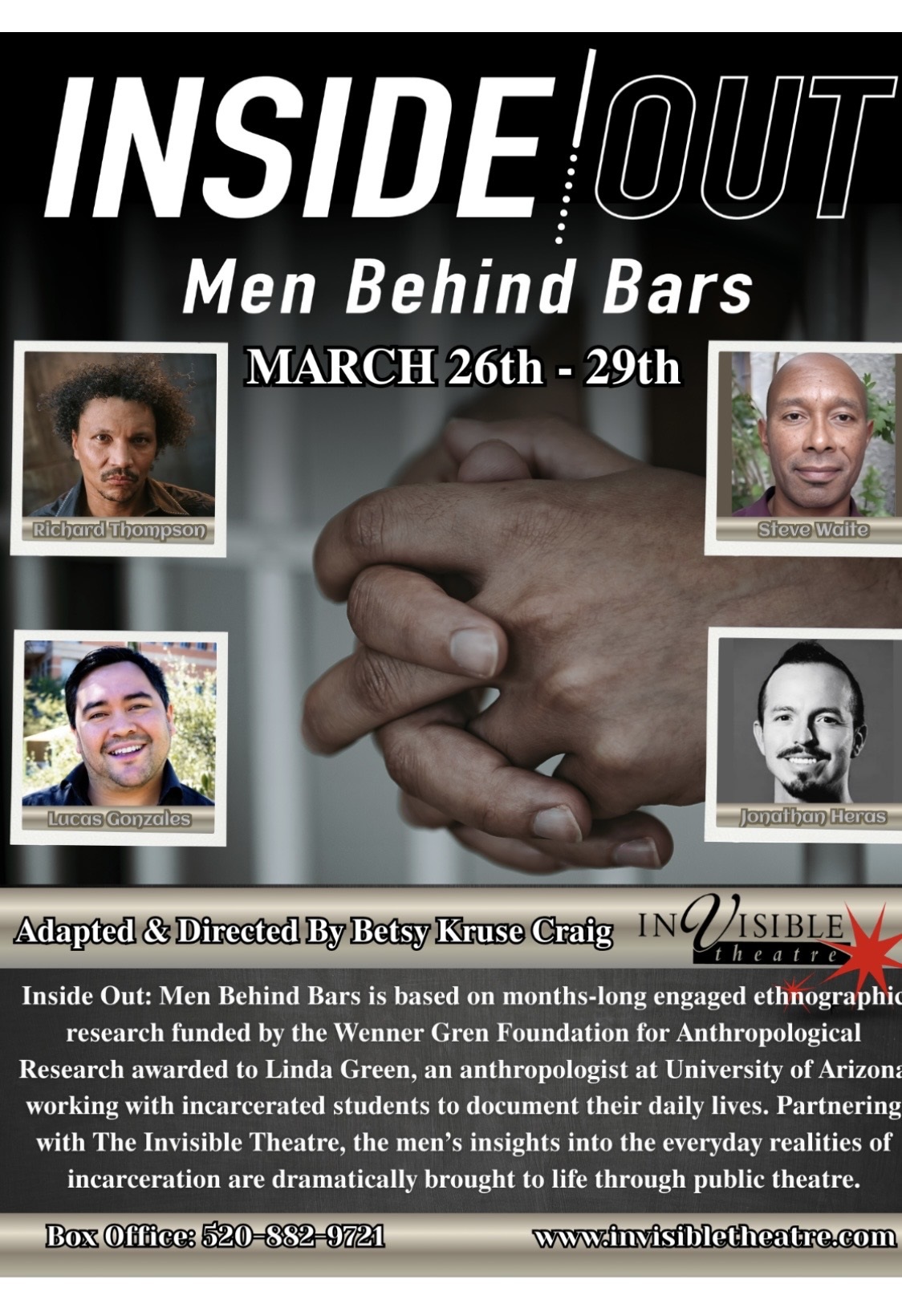
There were five live performances of the play produced at The Invisible Theatre in Tucson, over the course of four days in March 2026 to sell out audiences. Additionally, with permission from the US Dept of Justice Bureau of Prisons the actors were able to do two performances inside – in both maximum and medium security complexes. Over 100 inmates attended the productions. The theatrical performances was videotaped and there is with a link on the website https://www.insideoutmenbehindbars.com
Five of the PI’s University of Arizona undergraduate students conducted a short survey of people’s impressions as they left each of the theatre performances with 75 responses out of a total of 350 attendees. The vast majority of the responders noted that they had no real understanding of the daily reality of incarceration. The PI and Co-PIs have been invited to write a journal article for Dialectical Anthropology reflecting on their experiences of doing this project. The incarcerated students have now embarked on imaging part 2 that will focus on the promises and pitfalls of reentry.
Click the following link to watch a video recording of the performance: https://drive.google.com/file/d/1UWXnwVigImEc1q8bk1zW9MpB-9Ttf6W-/view