Fejos Postdoctoral Fellow: Yasmin Moll
We’re excited to share the following trailer and blogpost from Yasmin Moll who in 2023 was awarded a Fejos Postdoctoral Fellowship to aid filming, ” Searching for Nubia.”
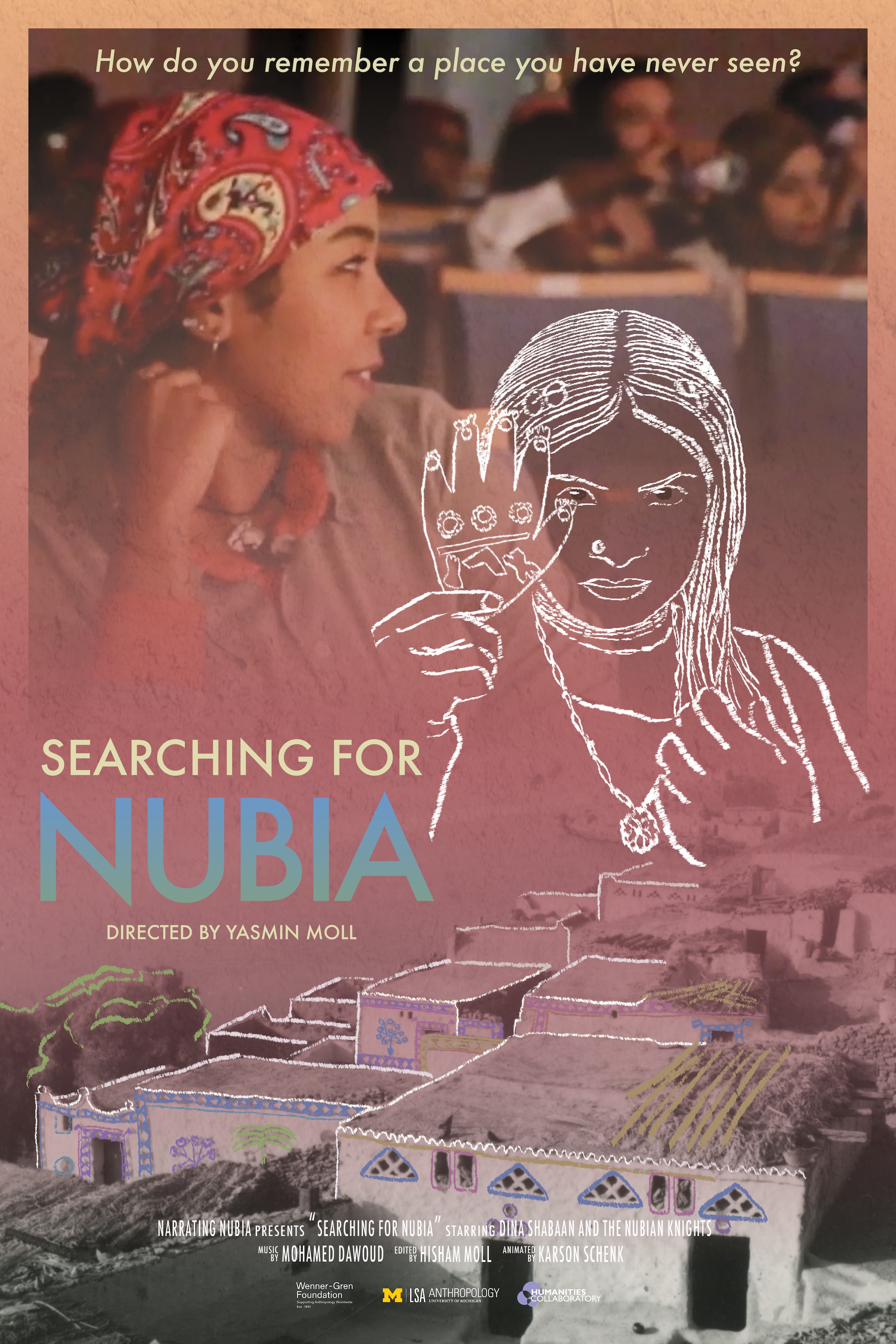
What does it mean to remember a place you have never seen? A new generation of Nubians battle misconceptions outside and inside their community as they search for a homeland lost but not forgotten. On the way they discover that finding home is never as simple as you imagine.
Film Synopsis
The last of a century-long series of dams displacing Nubians across Egypt from their ancestral lands straddling the Sudanese border was the Aswan High Dam of 1964. Since then, Nubians have kept the memory of their drowned homeland alive through stories, songs, and photographs. But each generation still has to discover for itself what it means to call Nubia home, and not every answer is accepted as accurate or appropriate by others. Searching for Nubia is about how the lived experience of finding home is never as simple as you imagine.
This is what Dina, the film’s protagonist, discovered when she launched the Nubian Knights in 2015. The Knights are a group of young Nubian friends who want to create more space across Cairo’s neighborhoods for their heritage and history. This is especially important given that they, like other black Egyptians, have to deal with racism and harmful stereotypes on a daily basis. They hope their music festivals, educational campaigns, language lessons and cultural celebrations will counteract the everyday discrimination and exclusion of Nubians by other Egyptians. The Knights also worry about how to keep Nubia alive for generations like theirs, born many years after the loss of their ancestral homeland. Their grassroots initiatives thus address both Nubians and non-Nubians since little is taught about Nubia within the Egyptian educational sphere.
But to their surprise, not all in the Nubian community like what they are doing. Instead of being celebrated, Dina and her fellow group members find themselves on the receiving end of criticisms questioning their commitment to Nubian identity and heritage. The film follows them as they grapple with the reality of multiple ideas of what it means to be Nubian in the present and contested ideas about what Nubia was in the past within the community in addition to contending with the suspicion and scrutiny of those outside of it.
As the tensions mount, Dina and her friends learn that their search for Nubia, for what it means to be attached to Nubia as a homeland lost but not forgotten, is ultimately about finding out what is important to them in the present as a generation of Nubians coming to collective consciousness at a time of social media polarization, shrinking space for public gatherings, fast-changing cultural norms, and economic precarity following the 2011 revolution in Egypt.
Community-Engaged Filmmaking and the Aesthetics of Accountability
I met Dina and the Nubian Knights in the summer of 2015, while attending a Nubian music festival they put on in one of Cairo’s most popular cultural centers. I was struck by the fact that most of the people at the festival were from the Nubian community, and that the festival reminded me of family Nubian weddings. I had already decided that my next film would be about the Egyptian Nubian community I had grown up identifying with through my maternal family, and by the end of the festival that day I had found my specific focus: my film would be about this group of young people’s hopeful “search for Nubia.” The Nubian Knights were both raising awareness about Nubian culture for non-Nubian Egyptians and creating a much needed space for a new generation of Nubians to come together as Nubians outside of private family gatherings.
Dina and the Nubian Knights welcomed the idea of working on the film with me as it fit within their own mission of highlighting Nubian heritage for multiply-positioned audiences. Between 2015 and 2019, I shot close to sixty hours of footage during my summer and winter trips to Egypt. This footage includes multiple interviews with Dina and other key members of Nubian Knights as well as observational footage of cultural events organized by the group and of aspects of Dina’s everyday life that are relevant to the film—for example, trying to learn the Nubian language, taking art and graphic design classes to create content for Nubian magazines, and spending time with her friends.
I received my doctorate in anthropology from NYU, where I also trained as a filmmaker in the anthropology department’s renowned Culture and Media program. While this project is my most ambitious filmic one yet, it also reflects a commitment to Nubian history that I first explored as a rookie journalist writing about the 40th anniversary of the High Dam before I knew what anthropology was. As one of just a handful of US-based scholars of Nubian heritage and, to my knowledge, the only one who is an ethnographic filmmaker, it was important for me that the film be a community-engaged project. The stakes of co-creative projects as a decolonizing practice are linked to the collective flourishing of community participants, as opposed to merely the redress of harmful representations or the external performance of identity.
Throughout, I asked what my doctoral mentor Faye Ginsburg calls an “aesthetic of accountability” could look like not just on screen but also in the production process. Nubian Knight group leaders shaped the film from concept to storyboard to production, suggesting which scenes to film, who to interview and where, what the throughline could be and what to leave out. I partnered with a Nubian musician that the Knight organizes performances for to record a soundtrack of traditional Nubian songs for the film. I co-edited a very rough cut with a Nubian filmmaker who wasn’t part of the group as a way of getting a different internal perspective, one of a distanced intimacy if you will, on the footage. Through the course of group discussions and re-viewing and analyses, the overarching focus of the film became the internal rifts and debates within the Nubian community over what being Nubian means and entails.
The film follows Dina as she tries to learn the Nubian language, brainstorms with her group ways to raise awareness about Nubian heritage, and acquires new digital skills to help grow the Knights. Through these scenes, viewers gain a vivid sense of the Knights’ struggles—most of them young women—to act on their own ideas of what it means to be Nubian all the while aspiring to assimilate to a typical middle-class lifestyle. Across different contexts, we see how they navigate their dual African-Arab identity within a society that does not recognize this possibility and deal with changing norms of interaction in relation to gender within an overwhelmingly conservative Nubian community. Through their stories, the film raises issues of much broader concern like racism, memory, displacement, and the politics of representation and solidarity.
As we moved to a fine-cut, we felt that something was missing. The whole film was about Dina and her friends’ “search for Nubia,” as one of them puts it in the first scene, yet Nubia was visually absent, implying that they never find it. This implication is antithetical to the film’s argument that Nubia lives inside us, guwanna, as Nubians often say. In response to this, Dina had the idea to incorporate animation into the film as a way of visually materializing “Nubia” into the film timeline. She was inspired to do so by the short animations I had directed on Nubian memories of the 1964 displacement that gave a new moving form to the salvage ethnographic photography of Nubia. As we experimented with this approach, we decided to create animations that also visualized some of the important events that Dina talks about which occurred before we started filming together. The film’s weaving together of interviews and observational footage with animation is thus the result of a highly iterative process of reflection between me as the director and the film’s main protagonist about effective storytelling strategies. In the time-honored tradition of ethnographic reflexivity, we decided that our conversations about the film should become part of the film. There is now a short scene after the credits of Dina and I watching the film’s fine cut together.
Funding from the Wenner-Gren Foundation’s Fejos Fellowship made possible the shooting of this scene as well as much of the film’s post-production, from moving from rough to final cut to color and audio corrections to the incorporation of the animation to the subtitling it into English.
Contribution to Anthropology
Searching for Nubia aims to take seriously the internal diversity and tensions of marginalized communities like the Nubian one, which are often both romanticized by members and stereotyped by outsiders. As a film, it makes vivid and concrete the often abstract themes of difference and belonging. Its subject matter of Nubians moves beyond the anthropology of the Middle East’s usual focus on religious difference while enriching the anthropological conversation on the lived experiences of racism, displacement and cultural erasure beyond Euro-American histories and their settler-colonial legacies. By incorporating animation into ethnographic film, Searching for Nubia also contributes to a more expansive practice of visual anthropology that unsettles the conventional opposition between the creative imagination of the not-here and the realist description of the out-there.
I plan to start submitting the film to festivals in June 2026, focusing on ones related to anthropology and to Africa and the Middle East. In October 2026, I will have a premiere within the anthropology department at the University of Michigan, which has been a key source of support since the start of this project ten years ago.